
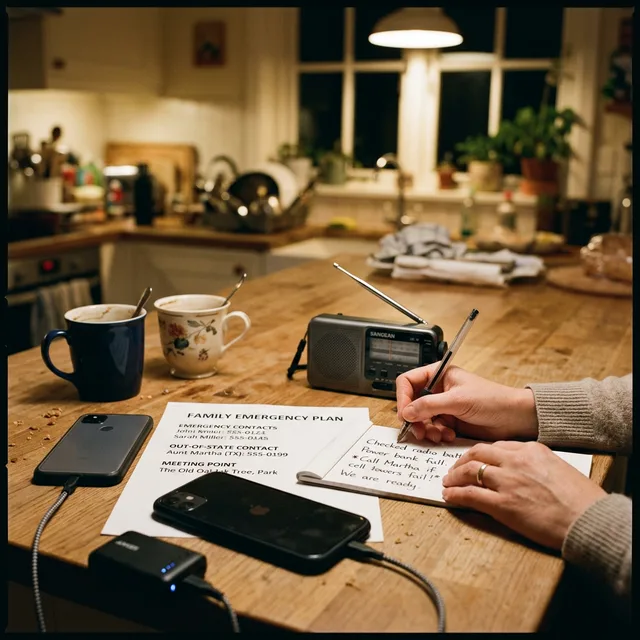
Most of us assume our cell phones will always work. But as seen during major hurricanes, wildfires, and the AT&T nationwide outage of 2024, cellular networks are surprisingly fragile. In a serious disaster, cell towers fail due to a lack of power or become instantly overloaded by panicked callers. First priority: make sure your phone has a full charge — a good emergency power bank is essential.
If you live in a city, the silence of a dead cell network can be terrifying. How do you find your partner? How do you know what the government is doing? The psychological toll of isolation is real. Here is your tier-based communication plan for when the network drops.
Tier 1: The Basics of Congested Networks
When a disaster strikes, the network might not be down, but rather congested (too many people trying to use it at once).
The Golden Rule: Text, Don’t Call. A voice call requires a constant, heavy stream of data to keep the connection open. A text message (SMS) is an incredibly tiny packet of data. When towers are congested to the point of dropping all voice calls, a simple SMS message will often slip through the cracks in the network traffic and reach its destination.
🔍 Reddit Insight: The Voicemail Trick
"If you absolutely have to get an audio message to family, don't call their phone—call their voicemail directly (using apps like Slydial or network-specific codes) or send a voice memo over iMessage/WhatsApp. It requires less continuous bandwidth than a live call." — r/preppers
Tier 2: Getting Information (NOAA Radios)
Your priority in an urban disaster is finding out what is actually happening.
Every apartment should have a crank/solar-powered NOAA Emergency Weather Radio. These tune into a dedicated nationwide network of radio stations broadcasting continuous weather information directly from the nearest National Weather Service office.
- Why it matters: In a massive grid-down scenario, local news stations may go off the air. NOAA stations are hardened against disasters and will give you the official word on evacuation orders or hazard warnings.
Tier 3: Two-Way Radios (Walkie-Talkies/GMRS)
If you need to coordinate with a partner who works across the city, standard “FRS” (Family Radio Service) walkie-talkies from Walmart are essentially useless in a concrete urban environment.
Instead, step up to GMRS (General Mobile Radio Service) radios.
- You need a simple license from the FCC (no test required, just a $35 fee), which covers your entire immediate family for 10 years.
- GMRS radios have significantly more wattage than FRS radios and, crucially, can connect to GMRS Repeaters.
- Many cities have robust networks of GMRS repeaters mounted on high-rise buildings. A repeater picks up your weak radio signal and blasts it out at high power across the entire city.
Tier 4: The Out-of-State Contact Plan
In localized disasters (like an earthquake or specific city blackout), local circuits get jammed because everyone in the city is calling everyone else in the city. However, long-distance lines are often free.
Pick a relative or friend who lives at least three states away. Both you and your local family members memorize their phone number. If you get separated during a disaster, do not call each other. Instead, all of you call the Out-of-State Contact. That person acts as the central switchboard, relaying messages between everyone in the disaster zone.
The Analog Backup: Rally Points
Technology fails. If the EMP hits, the cell towers burn, and the radios die, you must fall back to the thousands-year-old method: a meeting place.
Right now, establish three physical rally points with your partner or family:
- Primary: Your apartment.
- Secondary: A specific coffee shop or landmark three blocks away (if the apartment building is unsafe).
- Tertiary: A friend’s house in a completely different neighborhood or suburb (if the whole district is evacuated).
Without communication, chaos reigns. Set up your Out-of-State contact today, and buy a $30 crank radio tomorrow. It might be the only voice you hear in the dark.