
You pay rent. You share walls with strangers. You can’t run a generator, dig a well, or stockpile a year’s worth of food in a basement you don’t have.
And yet, when the grid fails, the water stops, or the evacuation order hits — you’re expected to survive with the same resources as someone on ten acres with a workshop and a root cellar.
The prepping community loves to imagine bugging out to the woods with 60-pound backpacks and hunting rifles. But if your daily reality is a one-bedroom on the 8th floor, that fantasy is worse than useless — it’s dangerous, because it keeps you from doing the real work that would actually save your life.
This guide is different. It’s built specifically for renters, apartment dwellers, and city people who have limited space, limited budgets, and zero permission to modify their homes. Every recommendation in this guide has been tested, debated, and validated by thousands of real urban preppers on Reddit’s r/preppers and r/urbansurvival communities.
Here’s everything you need to know.
Water: The One Thing You Can’t Survive Without
Water is simultaneously the most critical supply and the hardest to store in an apartment. It’s devastatingly heavy (8.3 pounds per gallon), takes up enormous volume, and can cause catastrophic damage to your downstairs neighbor if it leaks.
The standard recommendation is one gallon per person per day for drinking and basic sanitation. For a two-person household, a two-week supply means 28 gallons — roughly 233 pounds of water crammed into your living space.
Storage Solutions That Actually Work
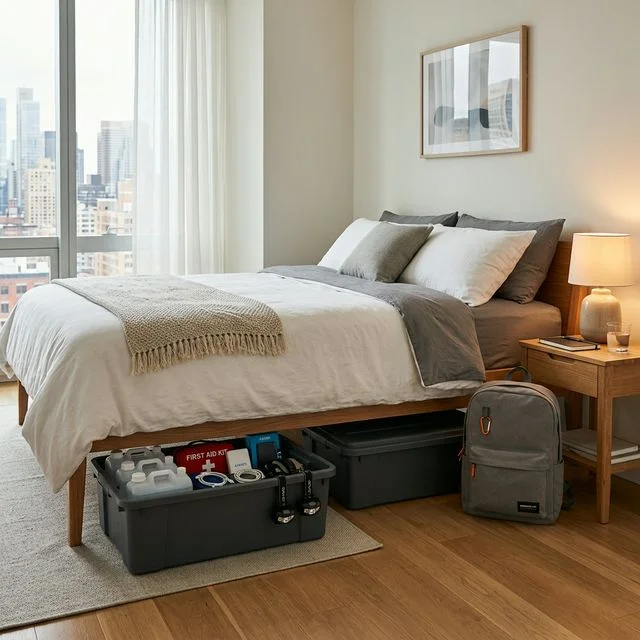
The key is finding dead space you’re already wasting. Our full under-bed water storage guide covers three specific methods, but here’s the priority order:
- WaterBricks under the bed. These interlocking 3.5-gallon containers lay flat and slide under a standard queen bed. Four to six of them gives you 14-21 gallons completely hidden from sight.
- The WaterBOB bathtub liner. When a storm is approaching, this heavy-duty bag fills your tub with 100 gallons of clean water. It’s the ultimate renter hack — takes up zero permanent space.
- Stackable 5-gallon jerry cans. These fit inside a closet or pantry corner and can be stacked to use vertical space.
When Stored Water Runs Out
If your supply runs dry and the city water is compromised, you need to know how to purify water without a commercial filter. Five renter-friendly methods — from rolling boil to DIY charcoal filtration — can make questionable water safe to drink using items you already own.
For those who want a dedicated filter, the two budget kings are the Sawyer Mini and the LifeStraw. We break down exactly which one to buy and why in our head-to-head comparison.
🔍 Reddit Insight: The #1 Beginner Mistake
"People will stock up 200 cans of food and have zero water plan. Water will kill you in 3 days. Food takes 3 weeks. Get your water squared away first." — r/preppers
Food Storage in Small Spaces
The biggest myth about food storage is that you need a pantry. Our small-space food storage guide proves you can hide two weeks of emergency food in a studio apartment using vertical hacks and dead space.
What to Stock
Focus on shelf-stable, high-calorie foods that require minimal or zero preparation:
- Tier 1 (Zero-prep): Energy bars, peanut butter, dried fruit, crackers, canned fruit
- Tier 2 (Hot water only): Instant oatmeal, ramen, freeze-dried meals, instant coffee
- Tier 3 (Cooking required): Rice, pasta, lentils, canned soup, canned chili
The key insight from r/preppers: stock foods you already eat. Rotating your supply becomes automatic when it’s part of your regular diet rather than a forgotten pile of MREs expiring in a closet.
Space Optimization Tricks
- Over-door organizers on closet doors hold canned goods, pouches, and granola bars
- Flat under-bed storage bins can hold 50+ cans
- Behind books on shelves — stack cans flat behind your regular bookshelf, invisible to visitors
- Furniture with storage — ottoman, coffee table, and bed frame compartments
Cooking Without Power
A Sterno can with a metal cup gives you hot coffee or ramen in 5 minutes. A compact camping stove with a single isobutane canister serves as a backup kitchen — but always use it near a cracked window for ventilation.
Critical safety rule: Never use a charcoal grill, propane BBQ, or oven for heating indoors. Carbon monoxide is odorless and will kill you before you realize something is wrong.
Power Outages: The Most Likely Urban Emergency
If there’s one crisis that every apartment dweller will face, it’s a power outage. Our apartment power outage survival guide covers the immediate response (first 30 minutes), and our in-depth 72-hour blackout guide walks through a complete timeline.
Lighting (No Candles)
Candles in apartments are a fire hazard, period. Instead:
- LED headlamps — The #1 recommendation from urban preppers. Hands-free, battery-efficient, and no fire risk. Hang one on your bedroom doorknob tonight.
- LED lanterns — Hook to curtain rods to light an entire room
- Glow sticks — Cheap, safe, perfect for bathrooms and hallways
Keeping Your Phone Alive
Your phone is your flashlight, radio, map, and lifeline. A dead battery is a genuine survival threat. Our power bank guide tests the top options, but the short version: buy a 20,000mAh USB-C bank ($30-40) and set a monthly reminder to keep it charged.
Winter Outages: A Special Threat
A winter power outage in a high-rise is genuinely dangerous. Without central heating, interior temperatures can drop into the 40s within 24 hours.
Our winter warmth guide explains the physics of staying warm: shrink your living space to one room, seal windows with blankets, layer clothing properly (wool base → fleece mid → windbreaker outer), and never wear cotton (it traps moisture and steals heat).
The “indoor tent hack” from r/wintercamping: set up a cheap 2-person tent on your mattress. Body heat keeps the inside at 65°F even when the bedroom is 40°F.
🔍 Reddit Insight: Power Outage Reality Check
"Do a trial run. Turn off all your power for 3 hours on a Saturday afternoon. You'll immediately discover what you actually need vs. what you think you need." — r/preppers
Sanitation: The Topic Nobody Wants to Discuss
When city water stops flowing, your toilet stops flushing. In a dense apartment building, this becomes a biohazard within 48 hours.
Our emergency toilet guide covers two phases:
- Short-term: The “bucket flush” — pour a gallon of saved water directly into the bowl, gravity does the rest
- Long-term: A two-bucket system with heavy-duty trash bags, sawdust, and kitty litter
This is the prep that separates someone who is uncomfortable from someone who is in a genuine health crisis. Take it seriously.
Fire Safety and Building Security
In a high-rise, fire is a fundamentally different threat. The fire rarely starts in your unit — it starts three floors down in someone else’s kitchen and pumps toxic smoke into shared hallways and ventilation.
Our apartment fire safety guide covers the critical “Defend in Place” strategy: when the hallway is filled with smoke, leaving your apartment can be a death sentence. Know when to stay, how to seal your door, and how to signal rescue crews from your window.
Door Security
The standard apartment deadbolt provides shockingly little protection. Most break-ins involve simply kicking through the door frame. Our apartment door security guide covers three cheap, non-permanent upgrades ($3 to $30) that dramatically increase your door’s resistance.
Evacuation Planning
If your building is on fire and you’re on the 12th floor, evacuation is a fundamentally different challenge than walking out a front door. Our high-rise evacuation guide covers what to know before it happens: stairwell locations, roof access, and what to carry when you leave.
For earthquake-prone areas, our apartment earthquake kit addresses the unique vulnerabilities of high-rise living — falling objects kill more people than building collapse.
Bags: Get Home, Go, or Bug Out?
The prepping community loves bags. Here’s which ones actually matter for apartment dwellers:
The Get Home Bag (Priority #1)
The real danger isn’t being trapped in your apartment — it’s being trapped across the city when the subway stops, the cell towers fail, and chaos starts. Our Get Home Bag guide covers exactly what to pack in a small shoulder bag that lives in your office desk or car trunk.
The Bug Out Bag (Priority #2)
If you need to leave your apartment fast (fire, gas leak, evacuation order), a pre-packed bag saves critical minutes. Our $50 budget bug out bag checklist proves you don’t need expensive gear — just the right priorities: water access, food, warmth, and light.
Communication When Cell Networks Fail
Cell towers are surprisingly fragile. They fail from power loss, get overwhelmed by panic, or simply go down during infrastructure failures. Our cell network outage guide provides a tier-based communication plan:
- Tier 1: Text-first (texts slip through congested towers when voice calls fail)
- Tier 2: Wi-Fi calling from cafés or buildings with generator power
- Tier 3: NOAA weather radio for official government broadcasts
- Tier 4: Physical meetup points pre-agreed with family
🔍 Reddit Insight: The Meetup Rule
"The single most important thing you can do: tell your partner or roommates 'If all communication fails, meet at [specific landmark] at noon.' That one sentence can save you days of panic." — r/urbansurvival
First Aid: You Are the First Responder
In a true disaster, 911 won’t answer. Ambulances won’t come. If someone in your apartment cuts themselves on broken glass during a blackout, or burns a hand on a camping stove, you’re it.
Our first aid skills guide covers five essential skills every renter must know: tourniquet application, wound cleaning, burn treatment, CPR, and choking response.
The Mental Game
Physical preps keep your body alive. Mental resilience keeps your spirit intact. The psychology of disaster preparedness is the most overlooked aspect of prepping — and arguably the most important.
Key concepts to understand before an emergency:
- Disaster Brain: Under extreme stress, your IQ drops 30-40%. You won’t think clearly. This is why you practice and plan now.
- Information Blackout Anxiety: Total silence is terrifying. Having a plan for how to get information (radio, neighbors, physical meetup points) prevents panic spiraling.
- The 72-Hour Emotional Curve: The first day feels like an adventure. Day two, the novelty fades. Day three, despair sets in. Knowing this curve in advance helps you manage it.
Building a Prep System on a Budget
You don’t need $5,000 in tactical gear. You need $20 and a Dollar Tree run.
Our 10 essential budget preps guide proves that the most impactful items cost almost nothing: a headlamp, a water container, a power bank, duct tape, and a manual can opener.
For the absolute lowest budget, our Dollar Tree prepping list identifies 15 survival items available for $1.25 each — gallon water jugs, candles, lighters, first aid basics, and trash bags.
The Monthly Prep Budget
The smartest approach from r/preppers is the “$20/month” rule:
- Month 1: Water storage (jugs + containers) — $15
- Month 2: Headlamp + batteries — $20
- Month 3: Power bank — $30
- Month 4: First aid kit — $20
- Month 5: 2-week food supply — $40
- Month 6: Water filter — $20
In six months, you’ve spent roughly $150 and you’re more prepared than 95% of apartment dwellers.
The 7 Beginner Mistakes That Will Get You Killed
Based on thousands of r/preppers threads, here are the most common — and most dangerous — mistakes new apartment preppers make:
- Prepping for the apocalypse instead of Tuesday. The most likely emergency is a 3-day power outage, not the fall of civilization. Prep for what’s probable.
- All food, no water. People stockpile 200 cans and have zero gallons of stored water. Water kills in 3 days. Hunger takes 3 weeks.
- Buying gear, not learning skills. A $200 first aid kit is useless if you don’t know how to apply a tourniquet. Skills take up zero space.
- Ignoring sanitation. Nobody wants to think about what happens when the toilet stops working. Think about it now, or deal with a biohazard later.
- Cotton clothing in winter. Cotton absorbs sweat, dries slowly, and actively pulls heat from your body. One wrong base layer can cause hypothermia.
- Candles in apartments. They’re a top cause of apartment fires. LED headlamps cost $10 and won’t burn your building down.
- No financial prep. An emergency fund of even $500 solves 90% of real-world “emergencies” — car repairs, surprise medical bills, temporary job loss — before they become crises.
Your First 30 Minutes: Start Tonight
Don’t try to do everything. Do one thing tonight:
- Buy a headlamp. Put it on your bedroom doorknob. When the power goes out at 2 AM, you’ll be calm while everyone else is stumbling in the dark.
- Fill a water jug. Put it under the bed.
- Charge your power bank. Set a monthly reminder.
That’s it. Three items, ten minutes, under $30. You’re now more prepared than the vast majority of people in your building.
Emergency preparedness isn’t about fear. It’s about being the calmest person in the room when things go wrong — because you already have a plan.